Birthday close to Christmas. One list, two occasions
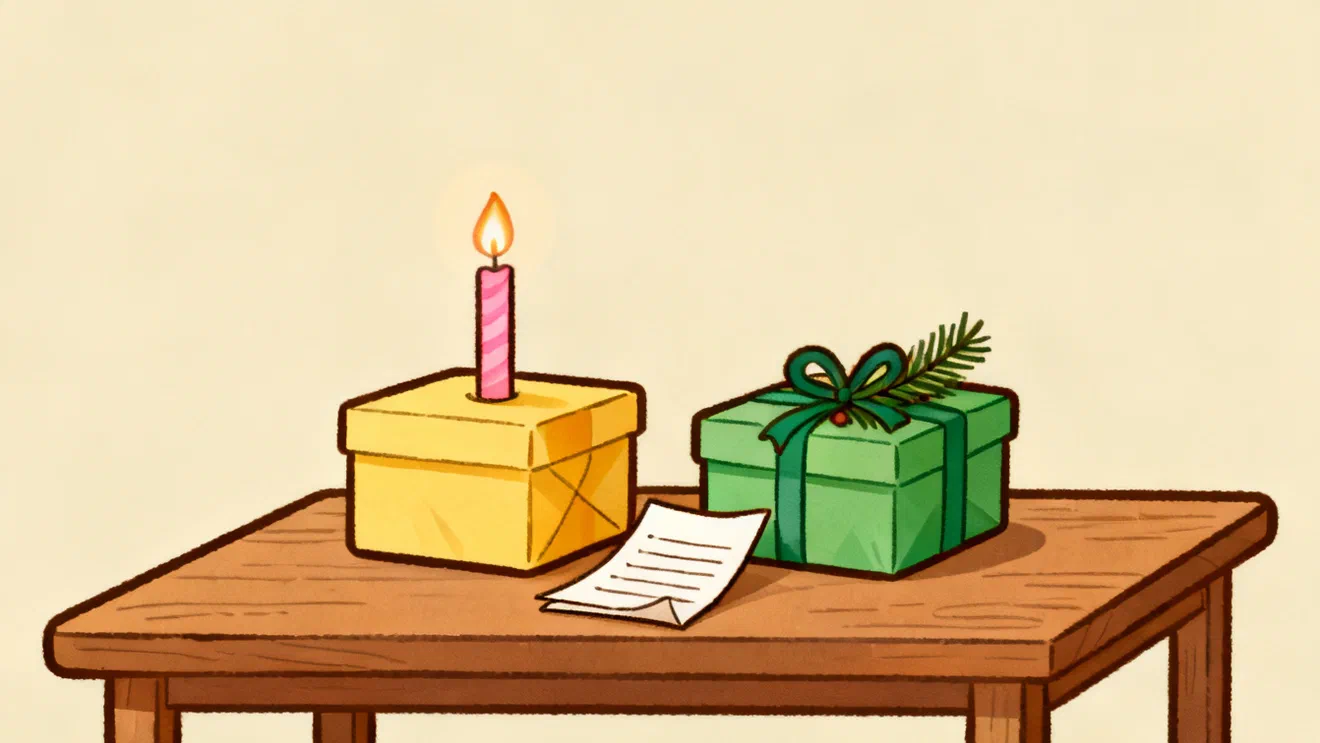
A birthday close to Christmas is a logistics problem before it is a feelings problem. One list for both days, not two. A short note on every item saying which day it is for. The list shared with everyone who buys, so that what the aunt gave in October is visible to the grandmother shopping in December. And the birthday wrapped in birthday paper, whatever month it falls in. That is the whole system. The rest of this is how to run it without a spreadsheet.
Why a birthday close to Christmas goes wrong
Most advice about this is about the feelings. Do not combine the days, do not let the birthday get swallowed. True, and not useful on December 19. The actual failures are mechanical.
There is one budget. A 15 year old on r/GiftIdeas this September posted a list for his October birthday and Christmas together, with a note at the top that it covered both, against a budget of under $300. The replies told him to pick one thing. Nobody told him which day that one thing was for.
There are two sets of buyers who do not talk to each other. The birthday is bought by whoever is around in October. Christmas is bought by everyone, including relatives who only shop in December and have no idea what happened at the birthday. So the grandmother buys for Christmas the headphones the aunt already gave in October.
And there are two lists, or none. Either the kid wrote one in September and it is wrong by November, because half of it was given at the birthday and nothing was crossed off. Or the list lives in a text thread with one parent and the relatives keep asking for ideas.
One list, with a day on every item
The fix for all three is one list covering both occasions, and a label on each line.
Two lists feel tidier. They are not. A relative who gets both links checks one, usually the Christmas one, and the birthday list goes stale on its own. With one list there is one link to send, one place to update, and one thing to check before buying.
The label is where the work happens. Three options are enough.
- “Birthday” for the one or two things the kid would hate to still be waiting for in December. These get bought first, by the people closest.
- “Christmas” for the bigger item, or the second bigger item, and anything that makes more sense under a tree than at a table in October.
- “Either” for everything else. Books, the game, the hoodie, the $15 things. Whoever buys first takes it, and the day sorts itself out.
That third label is the one most families skip, and it is the one that makes the list work for relatives. An aunt with $40 and a free afternoon in October does not need to know whether the hoodie was meant for Christmas. She needs to know it is open and that nobody minds which day it arrives.
The label is one word, so it fits anywhere, a paper list, a shared note, a wishlist app. In my own wishstack each wish carries a note, so the label is simply the first word of it. “Birthday. Size M, the dark green one.” I wrote about what else belongs in that note and none of it changes for a double occasion. The day goes first.
Relatives need to see what is already taken
This is the step that kills the duplicate. Not the labels, not the budget. Visibility.
The birthday happens. Five things on the list get given. If the list was a text sent in September, those five things are still on it as far as the grandmother knows, and in December she is shopping from a list two months out of date, in good faith.
So after the birthday the list has to change, and everyone has to be looking at the changed version. The low-tech way is a message to every relative the day after the party. “He got the headphones, the hoodie and the two games, everything else is still open.” That works as long as somebody remembers to send it, and some years nobody does.
The better way is a list the relatives see live, where whoever is buying can mark an item as taken. Then the aunt marks the headphones in October and the grandmother sees them gone in December, with no message in between. That is most of why I built wishstack the way I did. The list is shared by one link, relatives open it without installing anything, they get a push when something new is added, and the “I’ll get this” mark is hidden from the kid, so the surprise survives and the duplicate does not.
Either way, the list gets updated before the Christmas shopping starts, and the updated version is the one everybody has.
The combo gift, honestly
The advice everywhere is never do a combined gift. I think that is too strict, and it ignores the arithmetic.
If the budget is one amount for both days, and the thing the kid wants most costs most of it, the real choice is between one gift they actually want and two gifts they half want. A combo gift is fine. It is fine on one condition, which is that the kid agreed to it before either day, in words, with the trade spelled out. “The bike is your birthday and Christmas together. On the other day you get a few small things and a cake, not a second big box.” Said in September, that is a plan. Discovered on Christmas morning, it is a disappointment with a bow on it.
So on the list a combo gift gets its own label, “Birthday and Christmas”, and the other day still has to be a day. Something to open, even if it is the bottom of the list. A birthday with nothing to unwrap because Christmas already happened in October is the version people still bring up in their thirties.
How to split the big items when the list is five times the budget is in the teenager Christmas list post , and the ranking there is the same tool. Top item for one day, second item for the other, or one combo item with agreement and a real second day.
Never Christmas paper for the birthday
By the second week of November the shops have gone red and green. Every roll of paper, every bag, every card in the aisle is a snowflake or a reindeer. A birthday on November 20 gets wrapped in whatever is on the shelf, and the shelf says Christmas. The kid notices, and it is the thing they remember.
The fix is a cupboard. Buy birthday paper in September, when it is still in the shops, and put it away with the cards and the candles. Then on the day there is no decision to make and no trip to a shop full of tinsel.
Same goes for relatives who post both gifts in one parcel. Two wrapped things, two cards, a note on which is which. Late is fine. Merged is not.
The calendar in one place
For a birthday in late October or November.
September. The kid builds the list over a few weeks, every item gets a day label, and the parents mark their own picks so nobody competes with them.
Early October. The list goes out to everyone who buys, as one link or one message. Birthday items are the ones to buy first.
The birthday. Paper from the cupboard. Afterwards the list gets updated, by the buyers marking what they gave or by one message from you.
November and December. New wants get added and labelled as the kid sees them. The grandmother opens the list, sees what is gone, and buys from what is left. No duplicate headphones.
It is the same work as the usual version, moved forward two months and written down once instead of repeated in five text threads. The birthday gets to be a birthday, Christmas gets to be Christmas, and the family spends the same money with fewer apologies.