Gifts for someone you barely know. Ask the right person

The best gift for someone you barely know comes from someone who knows them well. Not from you, and not from a list of 38 things that suit everyone. You are two steps away from the answer, and the first step is finding the person who is one step away. Ask them for two or three specific things. Then buy one. The candle, the mug and the power bank are what you fall back on when that fails, and they fail less often than the listicles would like you to think.
I say this as someone who has bought the candle. More than once. It was fine. Nobody remembers fine.
Why guessing a gift for someone you barely know does not work
In one week this September, r/GiftIdeas had a person buying for a friend’s sister (“idk anything about her tbh”), a person meeting their boyfriend’s great aunt in Scotland for the first time, and an American visiting UK friends and wondering what to bring for their kids in their late teens and early twenties. All three did the same thing. They asked a few thousand strangers on the internet for ideas about a person those strangers know even less than they do.
That is the trap. When you do not know someone, the instinct is to widen the search. More people, more ideas, more lists. But every extra person you ask knows less than the one person you skipped. The friend knows the sister. The boyfriend knows the great aunt. The parents know the kids. The subreddit knows nothing, so it answers with the things that offend nobody, which is how you end up with a candle.
The other reason guessing fails is that a wrong guess for a stranger is worse than a wrong guess for a friend. A friend laughs and regifts it. A stranger keeps it out of politeness, or sells it. One reply in that UK thread put it bluntly. Bring a college cap for someone who did not ask for one and their eyes will light up at how much it fetches on Vinted.
Find the one person who knows them
There is always one. For a friend’s sibling, it is the friend. For a partner’s relative, it is the partner. For a colleague, it is the desk neighbor. For the kids of friends, it is the friends, who are also the people you are going to see anyway.
The mistake is asking that person the wrong question. “What does she like” gets you “oh, she likes cats” and now you are shopping in the cat aisle, which is how the great aunt ended up with a cat tea towel and the question of what could possibly tie it to a pumpkin candle. Vague in, vague out.
Ask for things, not traits. Two or three specific items, ideally with a link or a store name. Here is the wording I use, and it works because it gives the other person a small job instead of a big one.
I’m getting something for your sister and I’d rather get it right than guess. Is there anything specific she’s mentioned wanting lately? Even one thing helps.
Or for the kids of friends, where the parents are the source and the parents are busy.
Before I fly over, is there anything the kids have been eyeing that’s cheaper or easier to get here? Send me two or three things each and I’ll sort it.
Two things happen with wording like this. The person you ask feels useful rather than interrogated. And they answer with a noun. “She keeps talking about a specific water bottle.” “He wants the hoodie from that brand that doesn’t ship to the UK.” That is a gift. A trait is not.
If the person has a wishstack or any shared wish list, that is the same answer with the asking already done, but most near strangers will not, and you should not expect it.
What to ask for, and what not to
Ask for something under a price you name. “Anything around $30” saves the other person from suggesting a games console or, at the other end, a keyring because they are worried about your budget. Naming the number is not crass. Not naming it is what makes people hedge.
Ask for one thing they have mentioned, not the perfect thing. The perfect thing is a fantasy that stops people replying. “Something she said she wanted” is a memory, and memories come back quickly.
Do not ask for sizes unless you have to. Clothes for a stranger go wrong at the size, the cut and the color, and you only get one of those from a text. If the answer that comes back is a clothing brand, get a gift card for that brand instead of a garment. That is one of the few cases where the card is the thoughtful option.
And do not ask the person themselves, unless you already have a way to do it lightly. Asking a stranger what they want puts them in the awkward spot of naming a price. Asking the go-between costs nobody anything.
When nobody answers
Sometimes the go-between is useless. The boyfriend says the great aunt “likes her cats” and goes back to his phone. Now you do need a safe default, and it is not the listicle candle. It is this.
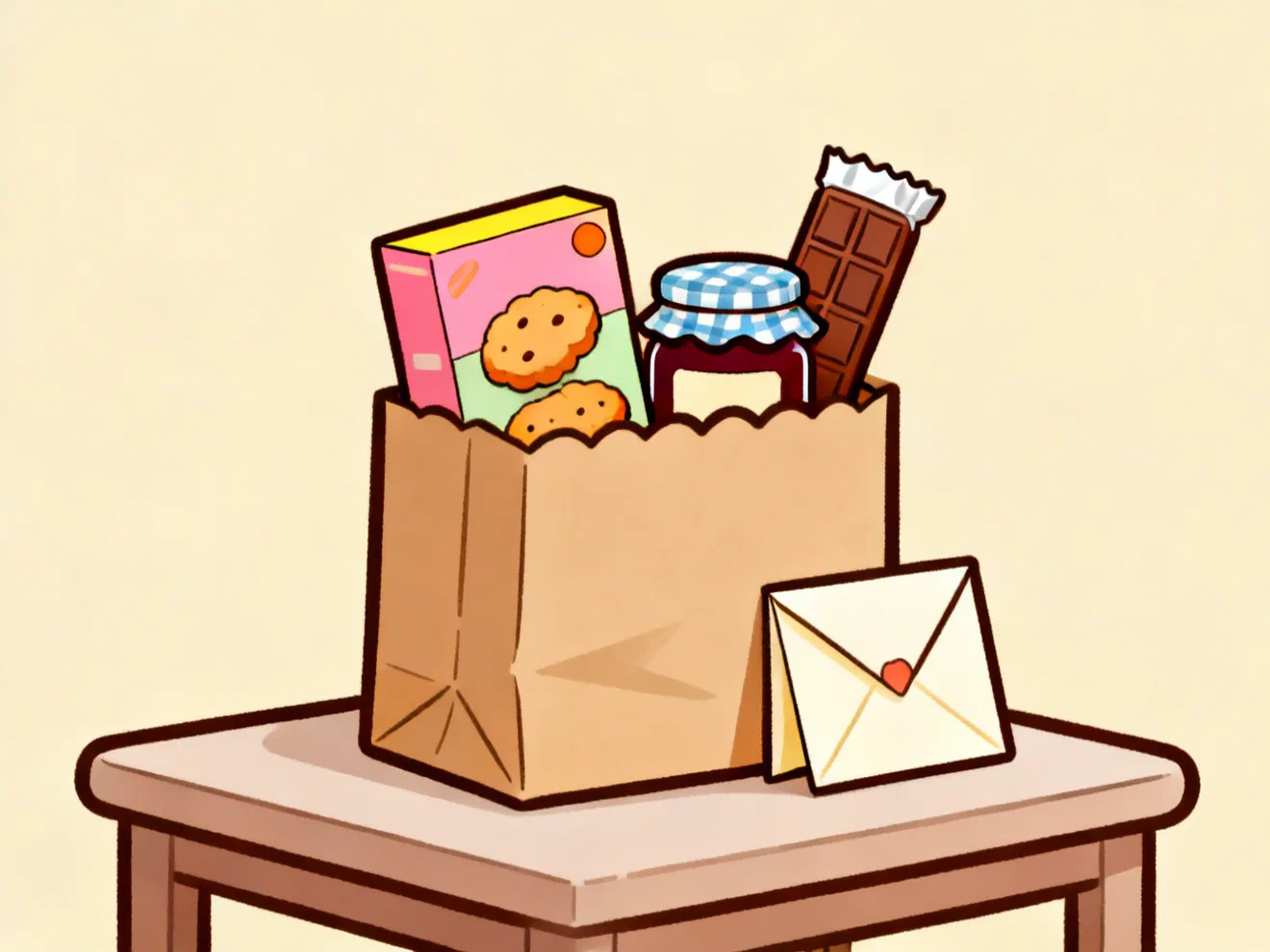
Something edible, something small, and if you are traveling, something from where you live. Older relatives especially like receiving a thing that came from somewhere. Good chocolate, a jam or biscuits from your town, a tin of the coffee you actually drink. It does not need to match anything else you bought. It just needs to be gone in a month, which means it can never be the wrong size, the wrong color or the wrong taste for longer than one evening.
For younger people the same rule holds with different goods. Snacks from your country are the safe bet for a twentysomething in the UK, and that is not a joke, it was the most upvoted practical answer in that thread. A big bag of American candy costs $15 and does not need a size.
The second half of the safe default is the card. A stranger cannot read your mind but they can read a page. Write four real sentences about why you are glad to be meeting them, or what their sibling or partner says about them. That is where the thought goes when the gift itself is generic. A tea towel with a card that says “Tom has told me about you for two years and I’m glad I finally get to meet you” is a different gift from the same tea towel with a signature.
What to spend on a gift for someone you barely know
Less than you think, and the same as everyone else in the room. The r/Parenting thread about a birthday party for a new friend’s toddler landed at about $30, and that number holds for most near strangers. I went through that party math in the first birthday list . Anything much above it makes the other person feel they owe you. Anything much below it looks like an afterthought, unless the whole thing is a card and a bar of chocolate, which is honest and fine.
For a first meeting with a relative, the budget matters less than the fact that you brought anything. For the kids of friends, split what you would spend on a single good gift across all of them so nobody gets the visibly bigger box.
The three cases, answered
The friend’s sister. Ask the friend for one thing. If nothing comes back, a small handmade thing is exactly right, a crochet keychain in one calm color, because handmade reads as effort and effort is what a near stranger notices. Do not shape it like a joke you are not sure she will get.
The great aunt in Scotland. The tea towel and the candle are already a gift. Add something edible from home and write the card properly. Stop at one cat item.
The friends’ kids. Get the list from the parents two weeks out. Anything with a brand and a size, buy the gift card. Fill the gaps with snacks.
None of that came from a listicle. It came from asking the one person in the story who could actually answer, and from having a small, edible plan for when they could not.