How to pool money for one big gift without chasing anyone
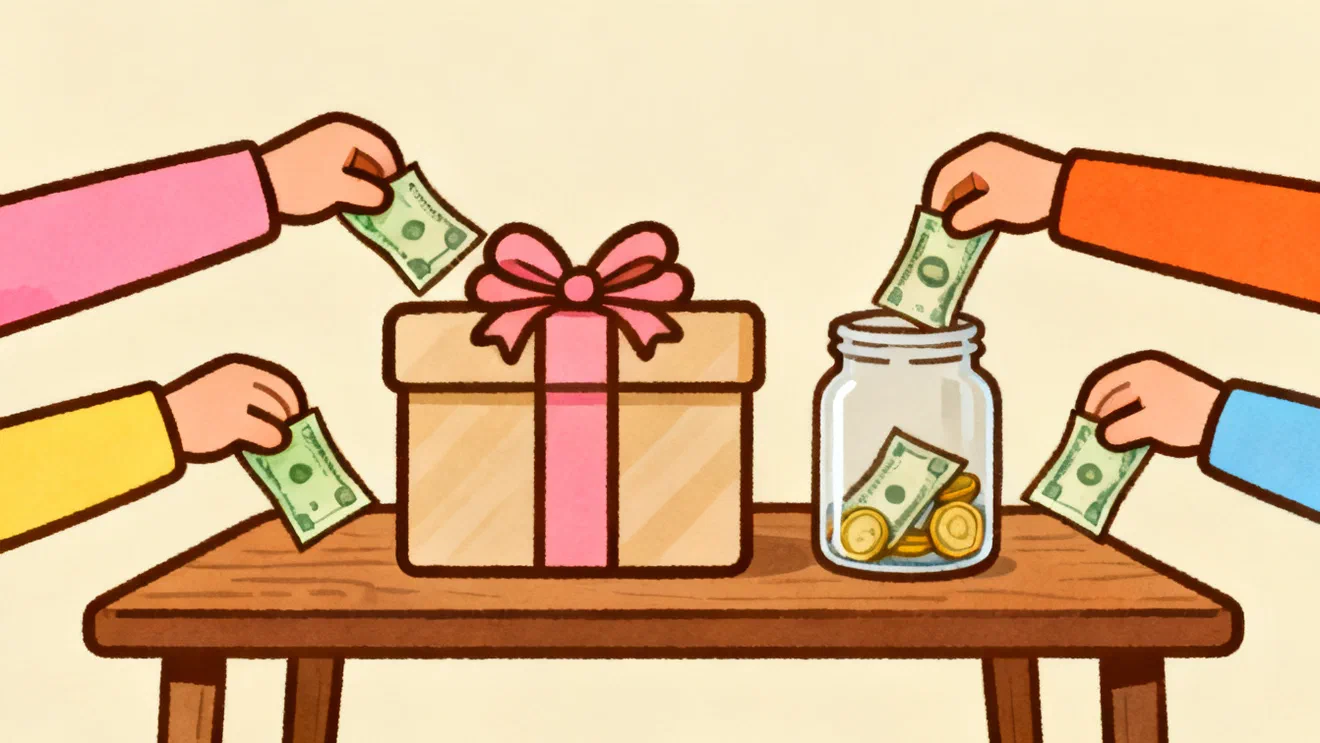
If you want to know how to organize a group gift, here is the order that works. Pick the item first and find out exactly what it costs. Count the people who will really chip in and divide. One person coordinates, and that person is the one who will actually buy the thing. They send one message with the amount per head and a date, keep a short list of who said yes, and buy on the date with whatever came in. Someone who never pays gets left out, not chased. That is the whole method. Most group gifts go wrong because one of those steps was skipped, usually the first one.
When to organize a group gift at all
Two threads from September sent me down this road. In one, a 15 year old posted his combined birthday and Christmas list on r/GiftIdeas, and it came to about five times what his parents could spend. Every reply said pick one thing, and he read that as getting nothing. In the other, on r/Parenting, a mother wanted ten gifts for her daughter’s tenth birthday and was short on both ideas and days.
Both have the same shape. There is a kid, one thing on the list that is too big for any one adult, and several adults around that kid who will each buy something anyway. Left alone, each of them buys a $40 thing, the kid opens six medium presents, and the scooter stays on the list for another year. Pooled, the same six people buy the scooter. The money just stops being split into pieces nobody wanted.
I wrote about the teenager side of that list . This is the organizer’s side.
Pick the item first, then the people
The most common failure I have seen, and done, is collecting first. You ask the family who wants in on “something big for Mia”, eight people say sure, you gather $180, and then the thing turns out to cost $240. Now you are paying the gap yourself or going back to eight people for a second round, and the second round is where it turns sour.
So the item comes first. Not a category, the exact one. The exact scooter, from the shop you will order from, at the price shown today with delivery. If the recipient has a wish list with a link on it, that is the price.
Then the people. Be honest about who will really pay, not who you could ask. Three reliable people beat eight maybes, because the per-head amount has to be a real number. $240 over six is $40, over four it is $60, and both work. $240 over “whoever comes through” does not.
If the item divided by the reliable people is more than those people would normally spend on this person, it is the wrong item for a group gift. Pick the next one down the list.
The coordinator is the one who buys
One person runs it, and that person is whoever will place the order. Not the most organized relative, not the one who had the idea, the buyer. Money has to end up in one place, and that place should be the account that pays the shop. Every handoff is a chance for the thing to be bought twice.
Bought twice happens more than it sounds. The coordinator orders the scooter, and grandma, who was never told it was handled, sees it on the list and orders it too. If the list lives in my app, wishstack, the coordinator taps “I’ll get this” on the item. The kid cannot see that mark, but every other relative looking at the list can, so nobody else buys it. That is the one thing the app does here. It does not collect money, so the pooling is still a human job.
One message with the amount and a date
The ask is a single message, sent once, to everyone at the same time. It has four things and nothing else. What the item is, with a link. How much per person. The date you need the money by. And how to send it.
“Hi all. For Mia’s birthday I’d like to get her the blue scooter she keeps talking about (link). It’s $240, so $40 each from the six of us. If you’re in, send me your $40 by the 12th, however is easiest, and reply here so I can keep track. If you’d rather do your own gift, that’s completely fine, just let me know.”
Notice what it does not have. No guilt, no “I know money is tight but”. No range, because “$30-50, whatever you can” means you will not know your total until the end, and the end is too late. And no second item. One gift per message.
The last line matters. An easy way to say no keeps the yeses honest. A person who cannot decline says yes and then does not pay, which is worse than a clean no.
Keep a visible list of who is in
As the replies come in, keep a list. Who said yes, who has paid, who said no. For six people that is a note on your phone. For a bigger group, a shared note with names and ticks, no amounts.
The list has two jobs. It tells you your real total, so you know whether you are buying the $240 thing or the $180 thing. And it stops you asking anyone twice. Keep the no list too. A no is finished business, and nobody on it should hear about the gift again until the day.
The deadline is a week before you need to buy
Whatever date you have to order by, the money date is a week before it. A week gives you room for the two people who pay late, for a shop that runs out of stock, and for deciding what to do if the total comes in short.
If you planned on six and four paid, you have $160 against a $240 item. With a week in hand you can quietly cover the difference yourself, pick the $160 version of the thing, or ask the four who paid whether they would stretch to $60. Any of those is fine. Finding out the night before the party is not.
The person who never pays
Someone will say yes and then send nothing. Usually they just forgot. The rule I use now, after getting it wrong for years, is one reminder, to the whole group, the day after the deadline. “Thanks to everyone who has sent theirs, I’ll order on Friday with what’s in.” No names. The people who have not paid know who they are.
Do not remind a third time. On the order day, buy with the money you have. If the missing share pushes the total under the item, that is what the week was for. The gift goes from the people who chipped in, and if the one who did not pay asks to be on the card, the honest answer, said kindly, is that it was the people who paid.
What you do not do is cover for them silently and resent it, or chase them for a month over $40. Both cost you more than the money.
What to say to the recipient’s parent
If the gift is for a kid, loop the parent in before the group message, not after. They may already have the item handled, and you need to know that before you collect a cent.
One message is enough. “A few of us want to go in on the scooter for Mia’s birthday. Is that still what she wants, and is anyone already on it? If not, I’ll organize it and you don’t need to do anything.” Most parents are relieved. The one time I did not ask, the parents had bought the exact thing two weeks earlier, and I found out at the party.
Kids move on, and the parent will know. If there is an expensive item on the list with a note under it, that note is usually the parent’s doing, and it is there to help you.
What a good one looks like
The group gift that goes well is almost boring. The buyer picked the item, sent one message with a number and a date, wrote down who was in, ordered on the day with what came in, and said thank you once. It is the opposite of an office collection , where the point is that the giving stays invisible. Here the point is that one thing on the list finally gets bought, and that only happens when someone decides to be the one who buys it.