How many items should a wishlist have?
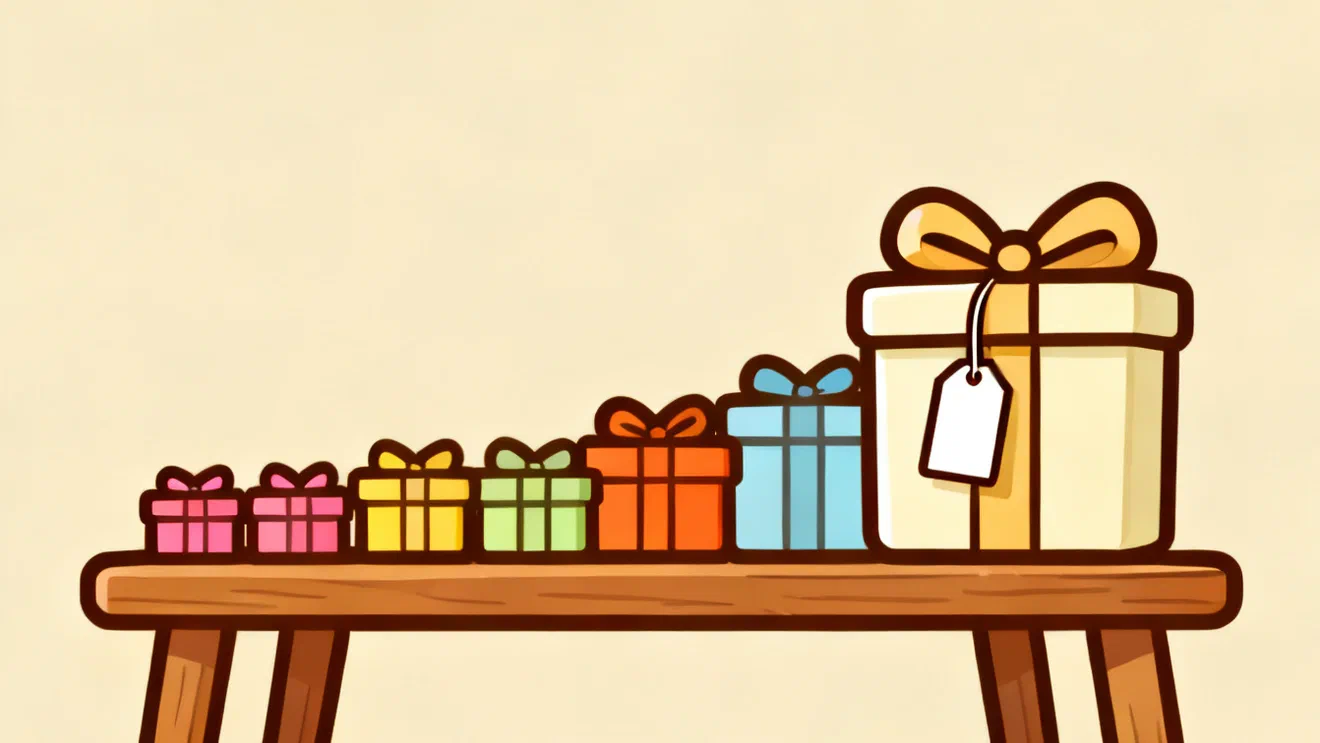
How many items on a wishlist depends on one number, and it is not your budget. It is how many people are going to open the list. One Secret Santa with a $30 cap needs three to five things. A family where a dozen relatives ask what you want needs fifteen to twenty. A birthday where a partner and a couple of friends will look needs six to ten. Every guide I have read says “8-15” as if it were a law of nature, and none of them say why. The number comes from the readers, so start there.
Why “8-15” is the wrong way to think about how many items on a wishlist
The advice is not bad. It is just an average of three different situations, and averages fit nobody.
A list has two jobs. It has to give every reader a real choice, and it has to leave the reader unsure which item you will end up with. Those two jobs pull in opposite directions. Fewer items means more certainty and less choice. More items means more choice and more work for whoever is reading. The right count is where those two meet for the specific people who will open the link, and that changes with the crowd.
So instead of one number, three questions. How many people will read this list? How far apart are their budgets? How long is the list supposed to live?
Count the readers first
One reader with a budget. A Secret Santa, a partner, a single friend. Three to five items, all inside the budget, one of them a safe pick that anyone could buy without knowing you. More than that and you have made a stranger do research. I wrote about this from the Santa’s side in the Secret Santa wishlist piece , and the short version is that a Santa with a deadline wants to close the tab, not browse.
A handful of people who know you. Birthday, a few friends, a partner, a sibling. Six to ten. Enough that the first person to open it does not take the obvious one and leave the rest with scraps. Few enough that the list still reads as “things I would like” rather than “things I have been meaning to buy”.
A family that asks. Two sets of grandparents, aunts, a brother who asks in October and again on December 22nd. Fifteen to twenty items, and this is the only case where the high end of “8-15” is too low. Ten people picking from ten items is a lottery where everyone gets the last one. Ten people picking from eighteen is a list.
Everyone, all year. A lasting list that friends subscribe to and that you add to whenever you want something. There is no ceiling here, and I will come back to that, because a growing list needs a different rule than a fixed one.
Then spread the prices
The count only works if the prices are spread. Ten items at $80 each is not a list of ten, it is one list for the person who can spend $80 and an empty page for everyone else.
A shape that has worked for me. A few things under $20 that anyone can grab, a book, a specific coffee, the socks you actually like. Most items in the middle, whatever the middle is for your people. And one big thing at the top, the $300 item, clearly marked as fine to split. A big item with “group gift ok” next to it is not greedy. It is how three cousins who would each have bought you a candle end up buying you the thing you wanted.
A 15 year old on r/GiftIdeas this September posted a seven item list for his birthday and Christmas combined. AirPods, an e-scooter, a GoPro, a Switch, games, a microphone, an air horn. His family’s budget was under $300. The list was roughly five times that, and the replies told him to cut it down to one thing. I think the count was fine. The problem was the shape. Six expensive things and one air horn is a list with no middle. The same seven items ranked, split across the two occasions, with the scooter marked as something relatives could chip in on, is a list a family can actually work with.
Three items is an order, forty is homework
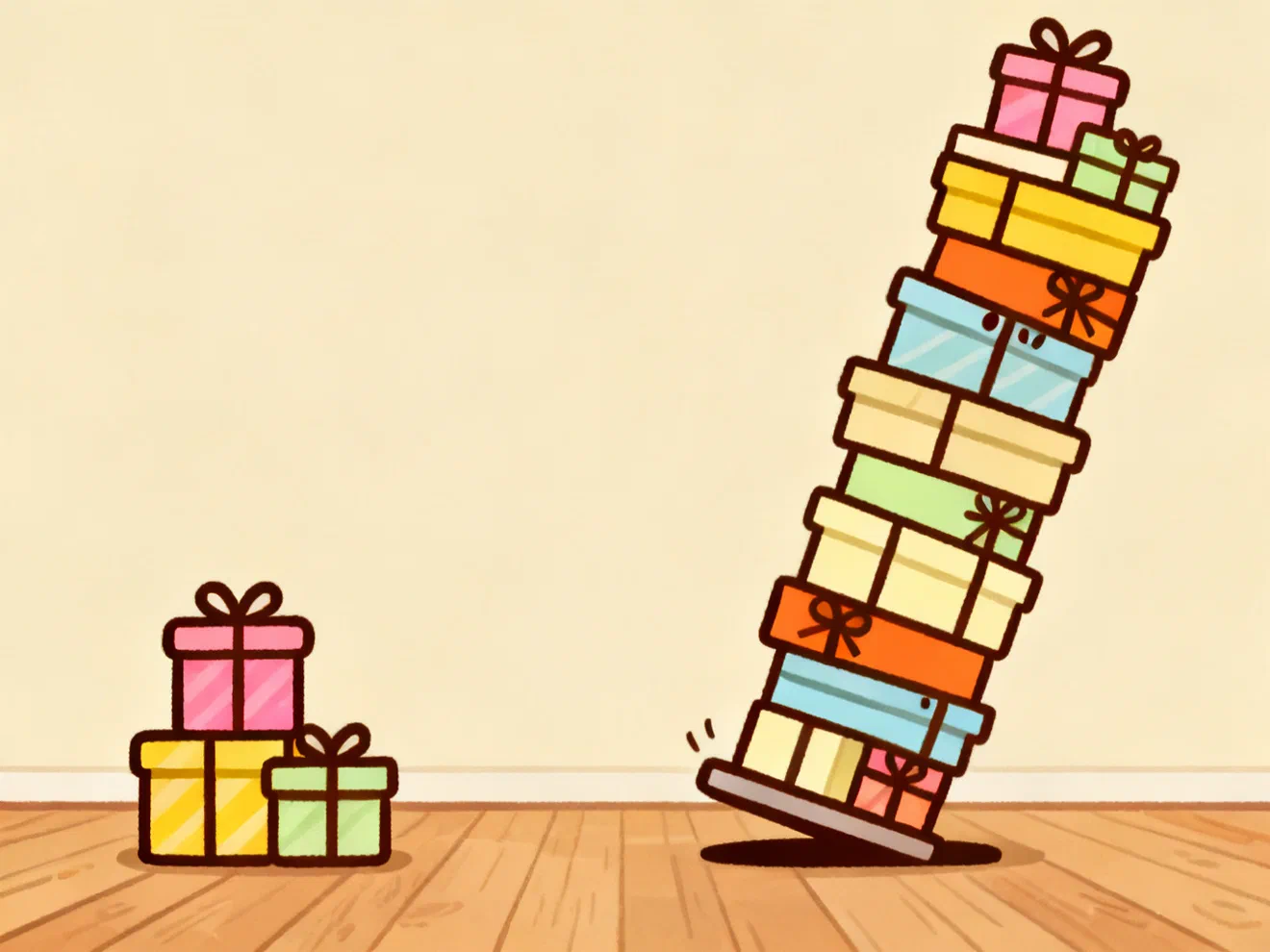
There are two failure modes, and both are about how the list reads, not what is on it.
Three items, all specific, all in the same price band, reads as a shopping order. The reader has no real choice. Whichever one they pick, you knew it was coming, and they know you knew. It is the list equivalent of handing someone a receipt. The exception is when someone asked for exactly that, “give me two or three things”, and then three is the polite answer. Unprompted, it is thin.
Forty items reads as homework. Nobody scrolls forty cards to pick a birthday present. They read the first eight, feel vaguely guilty about the other thirty-two, and buy something from the first eight. Which means the list was eight items long with thirty-two decoys. If you have forty things you want, you do not have a wishlist problem, you have a ranking problem.
Somewhere between is the range where a list does its job. I would put the floor at five for anything shared with more than one person, and the practical ceiling at about twenty for a list tied to an occasion.
When the list keeps growing
A lasting list, one that lives all year and that people can subscribe to, is different. It is allowed to grow. That is the point of it. The moment you want something, you add it, and the list is the place the wanting goes so it does not vanish before anyone asks.
Someone on r/GiftIdeas this September described the problem a lasting list solves. They always know what they want until it is time to write it down, and then the page is empty. That is not a memory problem, it is a timing one. Wanting happens in the shop, in a conversation, at 11pm on a product page. Writing a list happens in November under pressure. The only fix I have found is to write it at the moment of wanting, and then the November question answers itself. I went into the habit side of this in the piece about lists families actually use .
But a list that grows needs a top. When thirty items sit in a wishstack and a relative opens it in December, they need to know which five you would be happiest with. Most apps let you pin, star, or reorder. Use it. Move the five that matter to the top, and let the rest sit below as the long tail for the person who wants to surprise you with something you forgot you added. The count of the whole list stops mattering. The count of the top matters a lot, and it should be about five.
The other thing a growing list needs is pruning, and I mean actual deletion, not just pushing things down. Things you bought yourself. Things that made sense in March. The link that now points at a sold-out page. Once a season is enough. A list that only ever gets longer turns into the forty item homework case by accident.
The numbers, one more time
For one Santa, three to five. For a few friends, six to ten. For a family that asks, fifteen to twenty. For a lasting list, as many as you want, with five at the top and a cull every few months.
Spread the prices whatever the count. A few cheap, most in the middle, one big and marked as fine to split.
And if you are stuck at three because you cannot think of anything, that is not a short list. That is a list written on the wrong day. Add things when you want them, and the count takes care of itself.