How to help a teenager make a Christmas list that fits
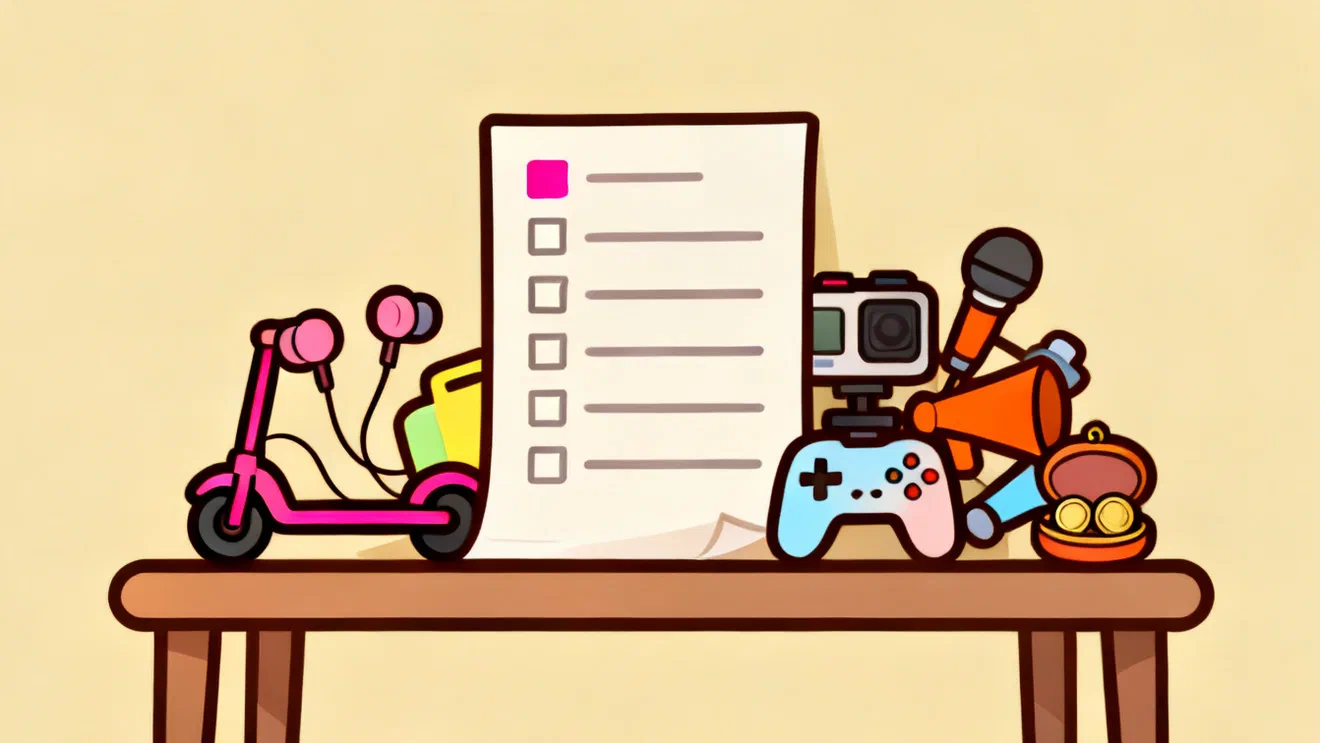
A teenager Christmas list comes in two versions. One is blank, because “I don’t know, nothing really”. The other is seven items of new electronics adding up to five times what anyone was going to spend. Both fail for the same reason. The list is being treated as a pile of wishes, when it needs to be a ranked list with a price on each line, split across whatever occasions fall close together, and shown to every relative who is going to buy something. That turns a list nobody can use into one that gets the kid more on the same money. Here is how I would do it, for both kinds of teenager.
The list that is five times the budget
A 15 year old posted his own list on r/GiftIdeas this September. AirPods Pro, an e-scooter, a GoPro, a Switch 2, some PS5 games, a wireless mic, and an air horn. His parents’ budget was under $300, covering his birthday in October and Christmas together. The replies were what you would expect, pick one thing. His answer was that it looked like he was getting nothing.
That reaction is the exact moment a teen decides lists are pointless. He was told to cut, and cutting a wish list feels like losing. The advice was also wrong, because “pick one” throws away the information in the other six lines.
The fix is to rank, not cut. Nothing comes off the list. Every item gets a number and a rough price.
The top slot is the one thing they would hate to miss. Ask it that way. Not “what do you want most”, which invites a shrug, but “if you got only one thing off this list, which one would make the others not matter”.
Then the middle. Things that are wanted but survivable. The mic, a couple of the games.
Then the cheap fun stuff at the bottom. The air horn. Snacks. The thing that costs $12 and makes opening presents actually fun. This tier is what turns one big box into a morning.
Now the list still has seven items, but it reads as instructions. The top is the parents’ gift. The middle is where grandparents and aunts shop. The bottom is stocking material. Nothing was lost, it got sorted.
One big thing per occasion when birthday and Christmas collide
That same kid had a birthday in October and Christmas nine weeks later, on one budget. A lot of families have this, and the usual result is one combined “big” present in December and a birthday that feels like a rehearsal.
The ranked list solves this too. Item one is for the birthday. Item two is for Christmas. Say it out loud, in those words, so the teenager knows the plan and stops treating both days as a lottery. If the budget genuinely only covers one big thing, then one occasion gets the big thing and the other gets the whole bottom tier plus something to do. A teen who knows the plan in October is fine with it. One who finds out on Christmas morning is not.
And write it on the list. A note that says “birthday” next to the scooter and “Christmas” next to the AirPods is the difference between relatives coordinating and relatives guessing. I said the same about grown-ups in what to say when family asks what you want for Christmas . It is more true for a 15 year old whose grandmother has $80 and no idea what a GoPro is.

Give the list to relatives, not just to parents
This is the step that most families skip, and it is where a $300 budget becomes more than $300.
The teen’s list usually lives in a text to one parent. The grandparents ask that parent what to get, the parent says “something for his room”, and the kid unwraps a lamp. Meanwhile the $40 mic, which a grandparent would have been delighted to buy, stays on a list nobody showed them.
So show them. Send the ranked list to everyone who buys for the kid. Grandparents, the aunt who always asks, the godparent. With the top item marked as taken by the parents, so nobody accidentally competes with it, and the rest open.
Two things happen. The middle tier gets bought by people who were going to spend that money anyway, on something worse. And the duplicates stop, because everyone is looking at the same list and can see what is gone. The alternative is texting the same list to five people and hoping, which works until two of them buy the same game.
I am building a small app for exactly this, called Wishstack. The kid pastes links, the list gets shared once, and whoever is buying can quietly claim an item so nobody doubles up. The teenager does not see who claimed what. It will not make the scooter cheaper. It does replace the five texts.
The list that is empty
The other teenager is the one from a second thread that same week. Mother of a 15 year old, budget of 100-250 euros, and the kid “doesn’t know what he wants”. What he does is film videos with friends, and hang out with friends, and that is it.
That is not an empty list. That is a list with the items missing and the category sitting right there.
The mistake with a blank-list teen is to ask once, at the dinner table, and take the shrug as the answer. Nobody produces a list on the spot. Adults cannot either, which is why “I always know what I want until someone asks” shows up in gift threads from people in their thirties.
What works instead is smaller questions over a longer time.
Ask about the thing they already do. “What would make the videos better?” gets a real answer. A mic, a light, a tripod, an SD card that does not fill up, editing software, a phone mount. None of that is a “gift idea”, it is a shopping list for the hobby, which is the point.
Ask what friends have. Teens know exactly which of their friends has the good headphones and which one has the thing they borrow. “What does Sam have that you keep borrowing” is a question with an answer.
Ask for categories, not items. “Something for filming, something to wear, something to do with friends, something dumb and fun.” Four categories, one thing in each, and suddenly a kid who had nothing has four things.
And give it time. Tell them the list exists and where it is, and let them add to it over a few weeks. Something they see in a shop in October, a thing a friend mentions in November. My own list works the same way, one item every couple of weeks, and by December it is long enough to be useful. I wrote about the habit side of that in how to make a wishlist your family will actually use . For a teen, the habit is the whole solution. A list built in one sitting is empty. A list built over six weeks has ten things on it.
The experience gift is the fallback, and a good one. The single useful reply in that thread was a trip to a theme park with his friends. For a kid whose entire interest is “friends”, that is the right shape. Put it on the list as an item with a price so relatives can chip in toward it, rather than as a vague idea only the parents know about.
What a good teenager Christmas list looks like at the end
Seven to twelve items, numbered, with a rough price on each. One or two lines at the top that the parents have marked as theirs. A note where birthday and Christmas split. A bottom tier of cheap things so relatives with a small budget still have somewhere to land. Shared once, with everyone, in October rather than December 20.
The list from that first thread was most of the way there. Seven items with a reason next to each, which is more than most adults manage. It needed numbers, a split, and to be seen by more than two people. A twenty minute fix. The kid was not asking for too much. He was asking one household for what should have been spread across four.